Gubbio

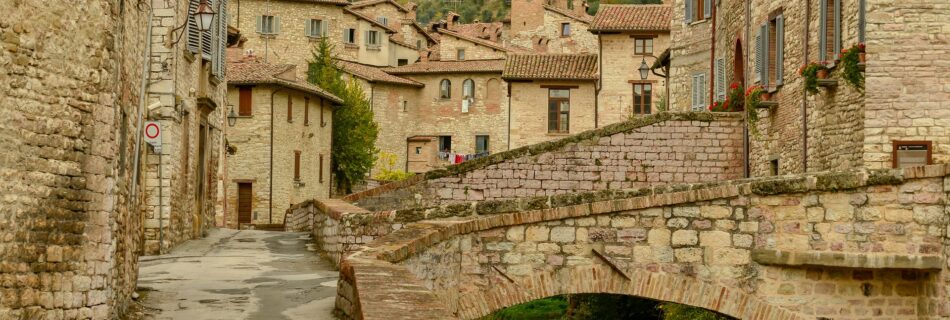
Gubbio is one of the oldest cities of Umbria, extremely well preserved during centuries and rich of monuments testifying its glorious past. Its origins date back to the height of the Umbrian civilization, as shown by the Eugubine tables, seven bronze tablets written in the Umbrian language preserved in the Museo Civico. Thanks to its thriving industry (specialized in the production of ceramics), the town reached its zenith in the fourteenth century: architectural masterpieces, that still can be seen in perfect conditions and that testify the power of this medieval city-state, were built in this period in Gubbio. At the beginning of the fourteenth century dates the construction of the magnificent architectural ensemble of Piazza Grande, supported by four large arches, close to which there are almost all the main buildings of Gubbio, such as the Palazzo dei Consoli (symbol of the city, and location of Picture-Gallery and the Archaeological Museum) and the Palazzo Pretorio (now the Town Hall). The shopping in the handicraft shops of the town is highly recommended: Gubbio also joins the “Italian Association of Ceramics Cities” for its secular tradition in ceramics field. A place of great natural interest, situated in the surroundings of the town, is the striking “Bottaccione Gorge”, which preserves some rocks which (at least according to a scientific theory) keep inside the secrets of the disappearance of the dinosaurs 65 million years ago. Also food and wine in Gubbio are of the highest level: the territory of this centre is in fact known for its white truffles, the most prized and valued quality of this tuber.

Città di Castello

Città di Castello is very rich in history and monuments and has a secular culture. The oldest part of the town, surrounded by long stretches of the sixteenth-century walls, preserves works of art of the highest quality, such as the elegant Renaissance buildings, the courtyards and the loggias of the noble palaces (Palazzo Vitelli is a wonderful example of the greatness of Città di Castello during the Renaissance), the cloisters and the naves of its churches (the monumental Cathedral, dating back to the XI century, preserves sacred art treasures). For these reasons Città di Castello is still one of the most important Renaissance architectural ensembles in Italy, especially because of its integrity. In this city it is also possible to admire masterpieces by Raphael and Luca Signorelli, as well as the complete collection of works by Alberto Burri, one of the great masters of international contemporary art, who donated all his works to his hometown. The many artistic, cultural and sports events (held in each period of the year) offer to the tourists the opportunity to make their stay in town more pleasant and enjoyable. Also the surroundings of Città di Castello are rich of sightworthy things: this allows tourists to discover places and artistic and historical memories following different paths: for example in the upper Tiber valley it is possible to choose many tours (on foot, on horseback or mountain biking) in order to enjoy the landscapes, the abbeys, the monasteries and the castles of the territory of Città di Castello.

Umbertide

Umbertide is located in a green valley (very fertile thanks to the presence of the Tiber river) dominated by Mount Acuto. The oldest part of the town is still surrounded by medieval walls: here it is possible to admire the Rocca, a superb medieval military fortress which has always been a symbol of the city. Following the impressive restoration works that took place in the Eighties, this fortress now houses the Centre for Contemporary Art: over the years very important exhibitions have been set up here, featuring the most talented and appreciated national and international artists. Other sightworthy buildings are the octagonal church of Santa Maria della Reggia, said Collegiata (XVI century), and the church of Santa Croce (1610), beautifully restored and converted into a museum (which preserves works by Luca Signorelli). Not far from Umbertide there is the Ranieri Pinewood, an oasis of refreshment for the inhabitants (23 hectares of greenery at disposal of citizens and tourists). From the pinewood it is possible to admire in all its majesty the Castle of Civitella Ranieri, a splendid example of medieval fortress. On another hill near Umbertide there is the Castle of Romeggio: this building as well dates back to medieval times, when these territories were crossed by the “Romei”, the pilgrims who came to Italy to visit the holy places of Christianity. The Castle of Polgeto (built in 1399) is not far from Umbertide too. Umbertide boasts of gastronomic products of high quality: this is the reason why this town is a step in the Strada del Vino (which means Wine Route) “Colli del Trasimeno”.

Cortona

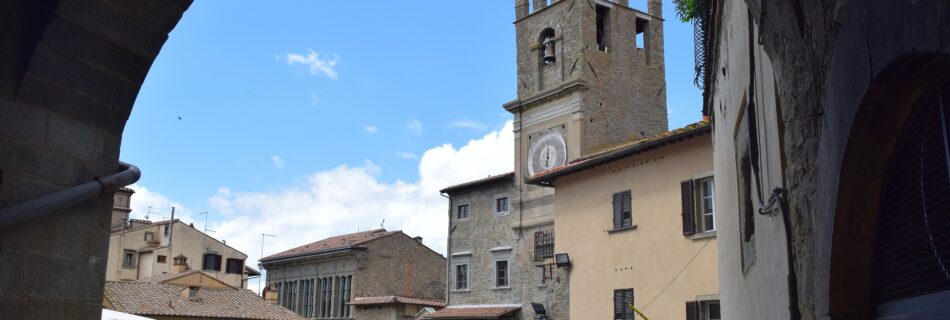
Cortona is one the main cultural and tourist centres in Val di Chiana. This city was an Etruscan settlement: of great importance are the archaeological sites of the Etruscan graves dating back to VII-IV century B.C. in the hamlet called Sodo (said “Melons” by local people for their particular shape) and the remains of the walls. In the twelfth century Cortona became a free city renowned for its arts and its crafts; it lost its independence in 1411, when it was sold to Florence. This city preserves extraordinary historical and artistic treasures, such as the precious palaces of the wealthy medieval aristocracy (among them, Casali Palace and Sernini Palace). Cortona also hosted famous artists such as Signorelli, Laparelli and Berrettini. The halls of the Museum of the “Accademia Etrusca” preserves an interesting collection of Etruscan and Roman archaeological finds, and the Diocesan Museum houses one of the most beautiful Annunciation by Beato Angelico. Cortona also boast of splendid churches, like St. Francis, the Duomo, Santa Maria delle Grazie in Calcinaio, the Franciscan Sanctuary of “Le Celle” and the beautiful Sanctuary of Santa Margherita, for which the local population has a particular devotion. An event hosted by this city is Cortonantiquaria, one of the most interesting national antique fairs.

Montepulciano

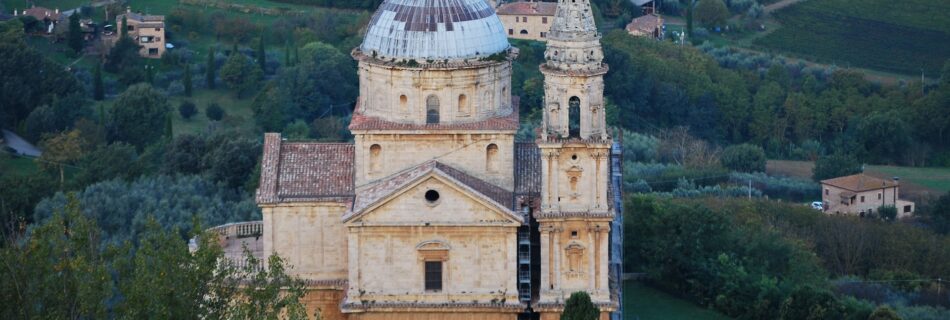
Montepulciano, city of Etruscan origin, is called the “Pearl of the Fifteenth Century” because it preserves the works by famous Renaissance artists such as Vignola, Sangallo and Peruzzi. Its history is particularly rich in events, especially since the Middle Ages: in fact, at the beginning of the fourteenth century the vitality of Montepulciano, promoted by its enterprising bourgeoisie, made it the subject of the expansionist ambitions of both Florence and Siena. In 1390 Montepulciano finally decided to ally itself firmly with Florence, which was extremely interested in having a strategic stronghold to the south of the territory of the rival Siena. Starting from this moment and until the middle of the sixteenth century, Montepulciano knew its golden age, characterized by political stability, cultural prestige and artistic flowering. This town is also famous for being the birthplace of the poet, humanist and dramatist Poliziano (1454-1494), who had the honour of being called to the court of Lorenzo the Magnificent. Montepulciano, in addition to being so rich in history and wonderful works of art, is also surrounded by a very suggestive landscape, characterized by extensive vineyards that make the town famous for its wines. Viticulture in Montepulciano dates back to Etruscan times, and the production of excellent wines, which was constant throughout the Middle Ages, has continued successfully to this day: the famous Vino Nobile of Montepulciano DOCG is protected by a consortium that brings together all the cellars since 1980.

Pienza

In the heart of Orcia Valley, Pienza was nothing more than a small village until 1462. The event that changed its fortunes happened in 1405, and it was the birth in the town of Enea Silvio Piccolomini, who would later become Pope with the name of Pius II. A trip to Mantua led Pius II to cross his birthplace: its degradation caused him to decide a total reconstruction of the ancient village, whose project was entrusted to the architect Bernardo Rossellino. The works lasted about four years and transformed Pienza into a typical Renaissance town. Most of the historical and artistic heritage of Pienza is concentrated precisely in the picturesque square dedicated to Pope Pius II, who did so much for his birthplace, trying to make it an “ideal city” of the Renaissance. The whole Orcia Valley is a world of flavors and aromas to be savored, but Pienza, in particular, is a jewel to be discovered for its gastronomic traditions: for example, Pienza cheeses are very famous (Pecorino cheese of Pienza is certainly one of the most popular). More and more tourists choose to visit Pienza because this town can perfectly combine the pleasures of art with those of authentic good food.